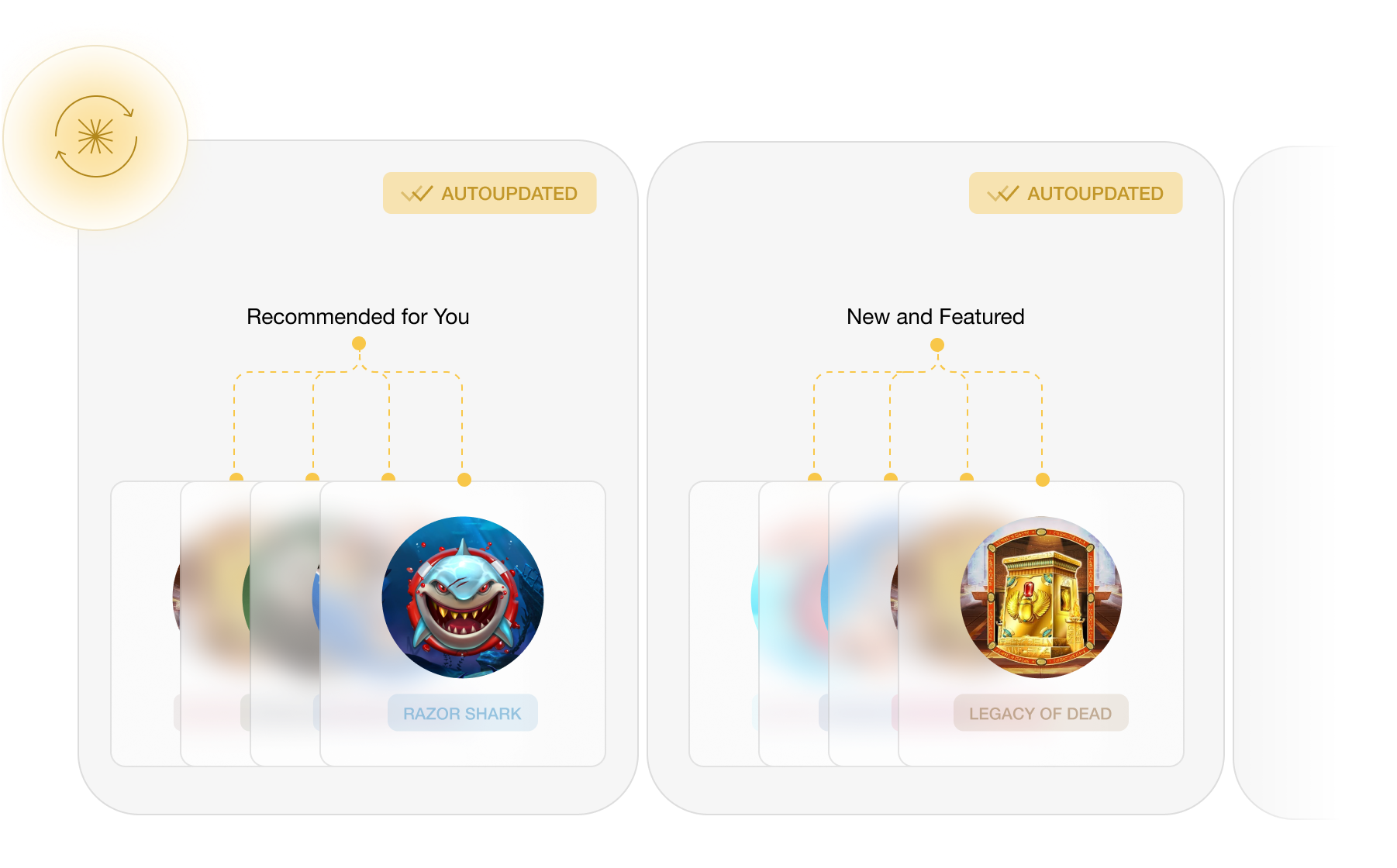
Players expect relevance from their first session. If discovery feels generic, they leave. For operators and platform teams, this shows up clearly: lobby click-through rates plateau, players stick to a narrow set of familiar titles, first session activation stays weak, and promotions start doing the job that product experience should handle. The operational cost is just as real: product and content teams spend time manually adjusting categories and ordering, usually after performance has already dropped.
This is why iGaming Lobby Optimization is no longer a UI concern. It’s a growth and retention level. And if your current approach relies on static ordering, broad segments, or brittle rule trees, you will eventually hit the same ceiling.
Why Most Lobbies Underperform
The core issue is simple: player behavior is dynamic, but lobby logic is static. Preferences shift session to session. Exploration patterns change. Risk tolerance evolves. Yet many lobbies still show the same ordering until someone intervenes manually.
That gap creates predictable problems. Discovery becomes inefficient because players keep seeing the same content whether it matches their current intent or not. Early sessions become fragile because new players aren’t guided to content that fits them quickly. Promotions start compensating for weak discovery, which distorts engagement and pushes costs upward. Finally, manual merchandising becomes a maintenance burden that scales poorly as volume grows.
If you’re trying to improve engagement by adding more campaigns on top of the lobby, you’re treating the symptom. The root cause is still the same: the lobby isn’t adapting.
Why Segments and Rules Don’t Scale
A common fix is to add more segmentation and automation. In theory, segments plus rules should personalize the lobby. In practice, they rarely do at scale.
Segments go stale quickly, because a player’s behavior shifts faster than the segmentation model gets updated. Rule trees grow into a complex web that becomes difficult to maintain, and every new edge case adds more “if/then” logic. Even worse, most rule-based systems are reactive. They explain what already happened and can’t reliably respond to what’s happening now.
This is why igaming lobby personalization based on static segments tends to plateau. The platform ends up with a “personalization system” that still treats most players the same most of the time.
The Shift: Lobby AI and Real - Time Personalization in iGaming
This is where lobby AI changes the model. Instead of relying on fixed segments and static ordering, the lobby can adapt continuously using real behavioral signals. This is real-time personalization in iGaming: game ordering and discovery flows adjust as the player’s intent changes.
In practical terms, AI-powered lobby personalization means the lobby is not just a catalog. It becomes a decision layer. Recommendations and ranking are driven by what players actually do - how they browse, what they engage with, how their preferences evolve - rather than by broad assumptions.
That’s the difference between traditional optimization and dynamic lobby personalization. The experience changes as the player changes, not after a manual update.
How AI - Driven Game Recommendations in iGaming Work
A modern lobby personalization software layer evaluates session-level and behavioral signals to rank and recommend games per player. The exact signals can vary by platform, but the operational principle is consistent: the model learns and updates ordering using live engagement patterns rather than static categories.
Behavioral inputs can include affinity signals (what types of content a player engages with), exploration signals (how they browse and switch), and intensity signals (how engagement changes over a session). The goal is not to flood the lobby with more content. The goal is to improve discovery efficiency - helping each player find relevant games faster and more naturally.
This is what AI-driven game recommendations igaming should deliver: individualized discovery flows that increase engagement without requiring constant manual merchandising.
You can think of it as a personalized discovery engine embedded into the lobby. It replaces one-size-fits-all ordering with an adaptive system that reflects intent.
Personalized Lobby iGaming: What Actually Improves
A personalized lobby igaming experience isn’t a cosmetic change. It changes measurable behavior. When ordering becomes relevant, players spend less time scrolling aimlessly and more time engaging. They discover content aligned with their preferences sooner. Early sessions become more decisive, which is critical for activation.
This is also where personalized game discovery igaming becomes a growth lever. Platforms stop relying on promotions as a substitute for relevance. Promotions can still be used, but they work best when they complement discovery rather than overpower it. With the right guardrails, the platform can prioritize business goals while keeping the experience individualized.
From a platform perspective, the outcome is not just higher CTR. It’s a healthier lifecycle. More players move into repeat behavior instead of dropping out early. Engagement becomes more stable, and retention becomes easier to manage because the experience is preventative rather than reactive.
A/B Testing and Rollout: Practical, Not Experimental Theater
Personalization only matters if it can be proven. That’s why the workflow should be built around controlled testing. Teams define a test category and success metrics - such as lobby CTR, session depth, or early activation - and run A/B tests on live traffic. When results are validated, the winning configuration is rolled out more broadly.
This keeps teams in control. You choose KPIs. You define business guardrails. You approve rollout rules. The system runs the modeling and experimentation. This approach turns personalization into an operational process instead of an ongoing manual project.
It also answers the question every technical buyer asks: “How do we know this works on our traffic?” With A/B testing, you don’t guess. You measure.
Integration Without Architecture Disruption
Good personalization fails if implementation is disruptive. The right approach fits into existing data pipelines. The system should connect to current event streams or frontend, ingest behavioral data securely, and deliver outputs in formats that are easy to consume.
In practice, recommendation outputs are delivered as structured daily feeds that the frontend or CRM tools can use. This reduces engineering effort and allows teams to deploy improvements without rebuilding platform architecture. Integration can be completed quickly when the requirements are clear and data access is organized - often within a few weeks - because the goal is to add an intelligence layer, not replace your stack.
Privacy also matters. A strong lobby intelligence implementation does not require PII. It can operate on behavioral data while keeping compliance and security requirements intact.
Platforms Matching Player Preferences With Casinos
In this space, you’ll often hear a simplified framing: platforms matching player preferences with casinos. The practical meaning - ignoring the wording is that modern iGaming platforms need to match player intent with relevant content efficiently. The lobby is where that match either happens smoothly or fails immediately. When discovery is generic, the platform loses attention. When discovery is personalized, the platform earns session depth and repeat behavior.
The lobby is the highest - leverage surface for making that “preference match” happen in real time.
What Success Looks Like for iGaming Lobby Optimization
When iGaming Lobby Optimization is implemented as a behavioral decision layer, teams typically see improvements in lobby engagement metrics, deeper sessions, and stronger early activation. Just as importantly, they reduce operational overhead by minimizing manual game ordering and reactive merchandising.
The measurable lift comes from the same principle: relevance increases engagement. When ordering reflects intent, the lobby does more work with the same traffic.
Who This Is For
This approach is built for teams that need personalization to show up in outcomes, not just in reporting. Product teams use it to improve discovery without redesigning the interface. CRM teams use behavioral outputs to support activation strategies. Content teams use it to avoid manual ordering that doesn’t scale.
If your team is serious about scaling personalization, the lobby is the place to start. It’s where discovery becomes behavior. And behavior becomes revenue.